

The Brief.
WiFi and wireless tech can now track you and "see" you—whether you're inside your home, at a public venue, in a doctor's office, or walking down the street.
This is real. The wireless signals coming from the WiFi router you own right now already have the ability to track where you are and where you're going inside your own home.
Very soon, this "Passive Sensing Technology" will be able to detect individuals—even in a crowded public space—right down to their heartbeat. At home, it will be able to pinpoint exactly which family member is in which room.
Key Takeaways
- The new WiFi is also a radar. The new WiFi standard, called 802.11bf, essentially turns your WiFi router into a radar system.
- The EMFs from your WiFi bounce off you and the system identifies you: Anything moving through a space where this Passive Sensing Technology is operating disrupts the EMF field, allowing the system to build a detailed picture of who you are.
- Don't rush out to upgrade your WiFi or even your smartphone: Avoid upgrading your WiFi router or smartphone unless necessary. The newest devices are the most likely to have 802.11bf and passive sensing technology built directly into the hardware.
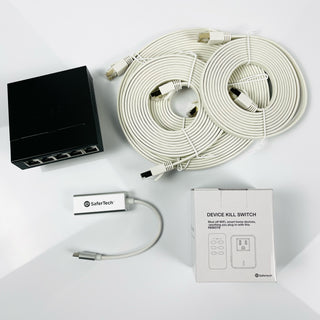
- Take control and shut it off. If your router has motion sensing features, turn them off in your provider's app. Better yet, switch off your WiFi when not in use, or hardwire your home with Ethernet cables to eliminate wireless tracking entirely.
- It's already here: MOST IMPORTANTLY, if you get your internet from Verizon, Xfinity WiFi, or Google Nest Home, this tracking is happening NOW.

I know this sounds like something straight out of Minority Report, but welcome to the new world we're living in. Soon, this technology will be built into almost every WiFi router sold.
WiFi Passive Sensing Technology takes the wireless EMF signals in a room and measures how they bounce off your body. As you walk across the room or sit down to watch TV, the system "sees" what you're doing—and will eventually identify you, based on your body shape and even the unique way you walk!!
How are they doing this without cameras? Through CSI. You'll hear companies talk about CSI, which stands for Channel State Information. CSI was originally built into modern WiFi chips to help routers adjust signal strength and overcome physical barriers in your home. But tech companies realized this detailed data does far more: it captures how radio waves bounce off living bodies. Now, by using AI, your router suddenly gains the ability to "see" motion, breathing, and physical presence—turning standard data signals into a continuous tracking feed. Your WiFi used to be about sending a signal to your laptop. Now look at it.

Here is how some of the biggest companies are already using it:
-
Verizon advertises motion-detection alerts in your home without invasive cameras, accessible by downloading "Verizon Home Awareness" through their app. (No invasive cameras, just very invasive WiFi!)
-
Xfinity has built WiFi motion detection into three of its newer gateways (XB7, XB8, XB10), claiming: "With high sensitivity, you may detect small movements like the wave of a hand." (Can you think of a reason why you'd want this? Creepy!)
-
Google Nest Hub tracks you "down to subtle chest movements," sensing your breathing and micro-body movements through its Sleep Sensing feature. (Well, since Google pretty much knows everything there is to know about you, it might as well know if you're breathing or not, right????)
And WiFi isn't the only technology using wireless signals to track and "see" you.
If you use sleep monitoring devices like Somnofy, Sleepiz, Sleepal, or SOMNDEEP, wireless technology is already built in to continuously scan and analyze your movements.
Companies like Origin Wireless partner with Internet Service Providers (ISPs) to enable WiFi sensing in homes, offices, and commercial buildings. Its founder explained:
"While the CSI is designed primarily for data communication, in recent years we discovered that to overcome interference from surrounding object movements, the CSI actually captures a huge amount of environmental information. In a nutshell, we perform Wi-Fi sensing by 'decoding' the information hidden in the CSI."
Emerging companies like Pulse-Fi and WICG have announced upcoming technology that can detect actual human heartbeats. Pulse-Fi claims that using standard WiFi alone, its product will be able to detect heart rates with $\pm 1\text{ bpm}$ accuracy from up to 2 meters away.
How Does WiFi and Wireless Sensing Technology Work?
The bottom line: WiFi signals (EMF) are constantly transmitted from a router to connect to your devices. When a living body steps into the path of those signals, the wave pattern is disrupted.
Some of that EMF bounces off your body, while some is absorbed directly into your tissue.
As signals bounce around, some arrive micro-seconds earlier or later. As the overall signal pattern is disrupted, it gets tracked. Routers capable of motion sensing analyze these tiny data shifts—known as Channel State Information (CSI)—to detect movement without needing a single camera.
Here's an important point: CSI is a standard feature baked into the WiFi protocol itself—not something that requires extra hardware beyond what many existing WiFi 6 routers already possess. It's not an add on or an option.
If you want to dig really deep, check this out: On top of CSI sensing—which was officially formalized as the IEEE 802.11bf WLAN Sensing standard—technologies like MIMO, (Multi-Input, Multi-Output) Beamforming, and AI are being combined to dramatically enhance motion tracking.
For example, many WiFi 6 routers use MIMO for beamforming, which works by measuring how radio signals bounce around your space to focus and optimize connection quality. But that exact same data can be repurposed to pinpoint where you are and how you're moving. Adding AI to the mix allows systems to process this raw data and create a detailed picture of your home environment—completely camera-free.
Will there be a test on this? Absolutely not! It's my job to get deep, deep, deep into the weeds and come out with actionable information for you--which is coming right up.
Some use the new 5G EMF called the Millimeter Wave
Some of the actual elctromagnetic frequencies used for sensing are the standard WiFi frequencies: 2.4 or 5 Ghz. The Google Nest Home and many other consummer products are starting to use the millimeter or mmWave to reflect off our bodies, often using specifically 60 GHz mmWave radar. So you'll be welcoming that lovely millimeter wave right into your home.
Sensing Technology or Not: Your Body is Absorbing And Reflecting WiFi Signals Today--But Some Sensing Will Make it Worse
Whenever WiFi's on- it's sending out a signal continuously, hoping to connect to a device. When it does and you're in the middle of it, you're being exposed to EMF. This is exactly why there's no WiFi in my house and why I encourage you to at the very least, turn your's off when you're not using it. EMF exposure is linked to oxidative stress, infertility, anxiety, loss of sleep, headaches and even cancer. Find out how it's affecting you here in our continually updated EMF GUIDE
What Can You Do To Avoid Wireless Sensing or Tracking or Detection?
- Hold off on upgrading needlessly: The newer the phone or router, the more likely it has sensing features baked in. Even if you don't enable these features, the hardware is present and could potentially be utilized by your Internet Service Provider or third parties.
- Speak up in public spaces: Share this information with your workplace, local school, or bank, and advocate for keeping WiFi Sensing features turned OFF in public spaces. No WiFi Sensing!
- Manage your current equipment: Many existing routers already support motion tracking using MIMO, beamforming, and CSI—even without 6G, mmWave, or Terahertz tech. If your router is sensing-equipped, disable the sensing feature, switch to a hardwired connection, replace it, or strictly limit when it is powered on.
-
Protect your sleep space: If you live in an environment with active WiFi motion tracking, I highly recommend sleeping under an EMF Protection Canopy. Our luxurious, natural cotton canopy blocks standard RF signals. (Note: High-frequency mmWave signals operate differently, so if your router explicitly uses mmWave radar, you will still want to disable or distance that router).

Honestly, this new technology is like a Tech Toxin DOUBLE WHAMMY!
Not only are you having to deal with EMFs from WiFi--now you're having to cope with EMFs that can track you and invade your privacy! Here's what you need to do to protect your privacy and your peace of mind:
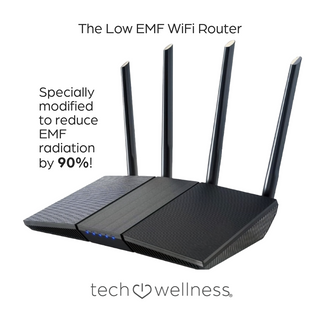
- Use a router you control: Choose an independent router—like our Tech Wellness Low EMF WiFi—running open-source firmware rather than using ISP-provided equipment.
- Keep routers out of private spaces: Never place a router in bedrooms or private spaces (and definitely not bathrooms!).
- Consider absorptive materials: Use protective solutions in sensitive areas, like our beautiful canopy.
- Monitor firmware updates: Check update release notes for newly added "sensing," "presence," or "motion" features.
- Reduce unnecessary coverage: Avoid placing mesh nodes in every single room. Ask yourself: Do we really need WiFi coverage in every corner of our home? (Like bathrooms and bedrooms???)
Our Specially modified Low EMF WiFi Router will reduce your EMF by 90% and it will NOT be able to track you. Ever.

Free of WiFi Sensing, Tracking or Motion Detection
How to See If a WiFi Router Can Stream Movies--And Also See If You're Sitting In Your Favorite Chair While You Do It!
🚩 RED FLAG KEYWORDS (Avoid on specs & marketing):
-
"Sensing," "Tracking," or "Motion Detection" in WiFi specs
-
802.11bf or WLAN Sensing
-
CSI or Channel State Information
-
"Motion data"
-
"Presence data"
-
"Occupancy information"
-
"Radio frequency sensing"
⚠️ HIGH RISK TERMS & FREQUENCIES:
-
mmWave or Millimeter Wave (20 GHz to 300+ GHz, Terahertz / THz)
-
Beamforming Feedback Matrix
-
"NFCSI" or "Native CSI extraction"
-
Origin Wireless integration
-
"Multi-band CSI" or "Tri-band CSI"
⚡ PROCEED WITH CAUTION (Look closely at these specs):
-
8x8 MIMO or higher / Beamforming
-
Chips engineered specifically for CSI extraction (e.g., Broadcom BCM4366/43684, Qualcomm QCA9886/QCA998, MTK Filogic 8000 series)
If you're as concerned about this as I am, we MUST vote with our wallets: don't buy into it while you still have the choice.
I am dedicated to helping you protect both your privacy and your well-being. Our Tech Wellness Low EMF WiFi router has no built-in sensing technology, and we've configured it to minimize raw EMF emissions and block signal manipulation for tracking.
Still, my absolute first choice will always be no WiFi at all.







Keith
Great